The Camden Town Group was a group of English Post-Impressionist artists active 1911-1913. They gathered frequently at the studio of painter Walter Sickert in the Camden Town area of London.
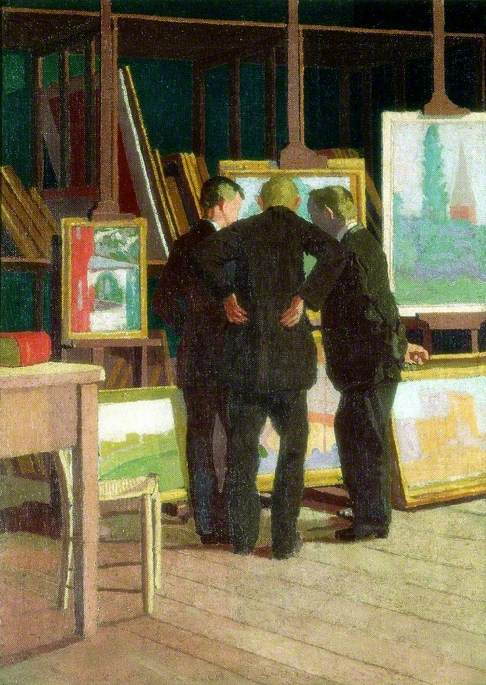
http://www.artuk.org/artworks/19-fitzroy-street-walter-richard-sickerts-studio-36172
In 1908, critic Frank Rutter created the Allied Artists Association (AAA), a group separate from the Royal Academy artistic societies and modelled on the French Salon des Indépendants. Many of the artists who became the Camden Town Group exhibited with the AAA.
The members of the Camden Town Group included –
| Walter Sickert | J.B. Manson |
| Harold Gilman | Robert Bevan |
| Spencer Frederick Gore | Augustus John |
| Lucien Pissarro | Henry Lamb |
| Wyndham Lewis | Charles Ginner |
| Walter Bayes | John Doman Turner |

Influences include Vincent van Gogh and Paul Gauguin whose work can clearly be traced throughout this groups work. Their portrayal of much of London before and during World War I is historically interesting and artistically important.
In the Cinema by Malcolm Drummond is noted for its claustrophobic feeling. It is an interesting foil to the work of Sickert who painted many rowdy music hall scenes, including Gallery of the Old Mogul (also depicting the viewers of a film).
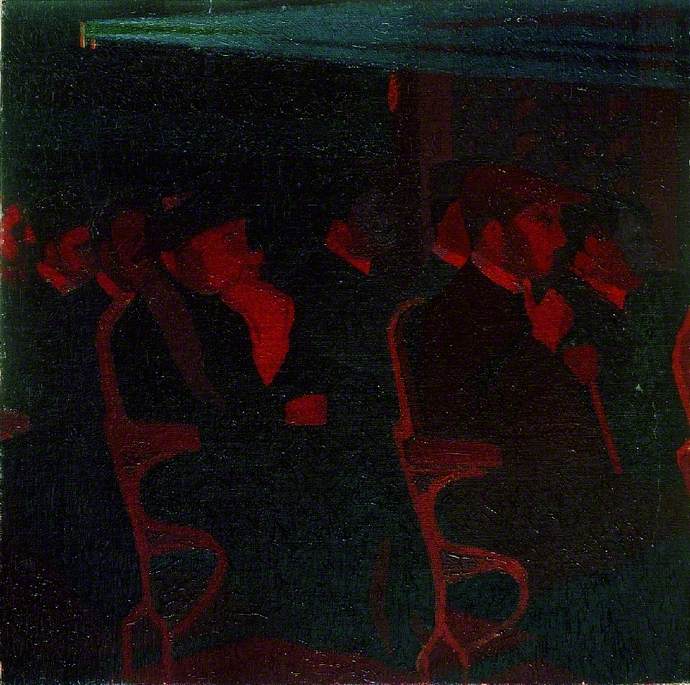
http://www.artuk.org/artworks/in-the-cinema-78471
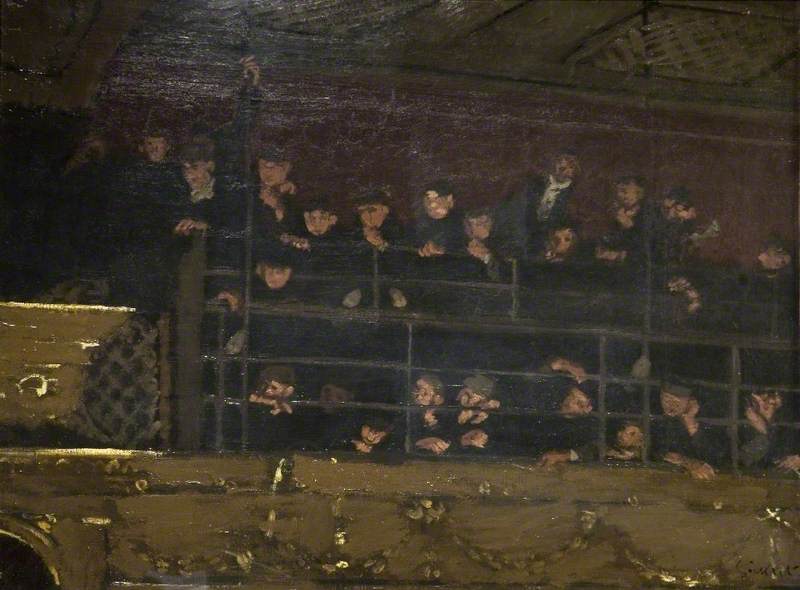
http://www.artuk.org/artworks/noctes-ambrosianae-gallery-of-the-old-mogul-33852
Sickert’s “Ennui” of 1914 is often considered the masterpiece of this group’s work, with its portrayal of boredom and apathy in the mould of Flaubert and others.

http://www.tate.org.uk/art/work/N03846
The group curated exhibitions showcasing Cubist and Post-Impressionist paintings, while a significant retrospective of their collective output graced Tate Britain in London in 2008.
You can see some of the art that was exhibited at the following Camden Town Group exhibitions at:
https://artuk.org/discover/curations/the-first-exhibition-of-the-camden-town-group-june-1911
https://artuk.org/discover/curations/the-second-exhibition-of-the-camden-town-group-december-1911
https://artuk.org/discover/curations/the-third-exhibition-of-the-camden-town-group-december-1912
Source: https://en.wikipedia.org/wiki/Camden_Town_Group.
In 2008, David Buckman, in a letter to the West End Extra, rightly lauded the fine artworks in the Tate Britain exhibition “Modern Painters: The Camden Town Group“. However, he pinpointed an inaccuracy in the Tate’s assertion that the exhibition was the “most comprehensive critical survey of the group’s work to be shown in Britain for over 50 years.” This assertion rests on two primary faults: the exhibition’s scope and its contents.
The Tate’s exhibition featured a mere 102 artworks by nine artists, with Walter Bayes and Lucien Pissarro each represented by a single piece. Consequently, the exhibition excluded contributions from the other seven original group members: James Dickson Innes, Augustus John, Henry Lamb, Wyndham Lewis, Maxwell Gordon Lightfoot, James Bolivar Manson, and John Doman Turner (Duncan Grant assumed Lightfoot’s role after his departure).
This underscores the importance of ensuring the representation of John Doman Turner in forthcoming exhibitions.
For a more extensive exploration of the Camden Town Group, visit the Tate website at https://www.tate.org.uk/art/research-publications/camden-town-group.
 John Doman Turner